
Big Tech shapes the way we connect, one app at a time. These companies power the systems behind our phones, cloud storage, smart tools, and even the content we see online. Behind every message sent is technology they built. Businesses depend on their networks, and personal information is often stored on their platforms. Many industries grow with the help of their services, and everyday communication runs smoothly because their technology keeps working.
With such influence comes close attention. Big Tech companies are often questioned about responsibility and ethics by governments, experts, and everyday users. To understand today’s digital world, it helps to know who these companies are, what they control, and how their decisions affect our lives.
What Does “Big Tech” Mean?
Huge tech firms shape how people connect, work, and share information across continents. Their reach stretches far because billions rely on their platforms daily. Power shows up quietly in what gets seen, shared, or hidden online. Size isn’t just about money; it’s about control over tools everyone now treats as essential.
Big Tech traits include scale dominance, influence, and data reliance
- Folks around the world use what we offer. Our work reaches far beyond one region
- Massive revenue and market value
- Dominance in specific tech sectors
- Continuous Innovation and Investment in Research
- Control over widely used platforms or ecosystems
One way people talk about businesses running entire fields goes something like this:
- Search engines
- Social media
- Cloud computing
- E-commerce
- Consumer electronics
- Software platforms
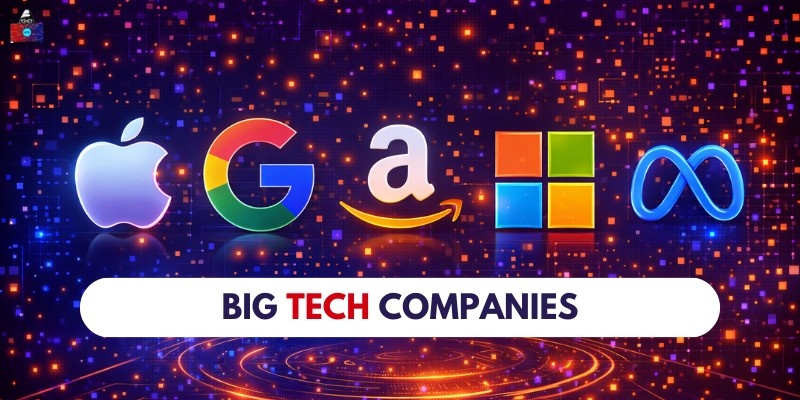
Few folks mention tech giants without bringing up FAANG. Facebook kicks it off, Apple follows close behind. Google holds a spot near the middle of the list. Netflix used to be there for a while, but was later replaced by Amazon. This lineup pops up again and again when people talk about dominant online companies
- Facebook (now Meta)
- Apple
- Amazon
- Netflix
Now it covers more than just the usual names; firms like Microsoft, NVIDIA, and Tesla also fit inside.
Top Big Tech Companies in the World
1. Apple
Apple is one of the largest technology companies in the world by market value. Founded in 1976, Apple revolutionized personal computing and later transformed the mobile phone industry with the iPhone.
Key products and services:
- iPhone
- Mac computers
- iPad
- Apple Watch
- iOS and macOS
- App Store
- Apple Music and iCloud
Starting off with sleek gadgets, Apple ties together devices, programs, and online tools without hiccups. Because attention lands firmly on how things look, feel, and protect personal data, it ranks among the world’s priciest labels.
Impact:
From Cupertino came devices that changed pocket habits, shifted app culture, slowly rewired spending taps on glass screens. A quiet force in pockets worldwide, shaping glances, swipes, moments between notifications.
2. Microsoft
Microsoft is a global leader in software, cloud computing, and enterprise technology. Founded in 1975, it became dominant through its Windows operating system and Office productivity suite.
Key products and services:
- Windows OS
- Microsoft Office
- Azure cloud platform
- Xbox
- Microsoft Teams
Now leading with cloud services, Microsoft powers ahead as Azure ranks among the globe's major platforms. Though once known for software, its shift places it firmly at the front line today.
Impact:
Firmly rooted in global operations, Microsoft runs the software backbone for countless businesses worldwide. Systems that handle daily tasks rely on its technology to stay functional across continents. Infrastructure within large companies often ties back to platforms built by this firm. Tools designed for teamwork and efficiency come alive through its consistent engineering efforts.
3. Google (Alphabet)
Google, owned by Alphabet Inc., is the world’s most popular search engine and one of the most influential technology companies.
Key products and services:
- Google Search
- YouTube
- Android OS
- Google Maps
- Gmail
- Google Cloud
- Google Ads
Most smartphones around the world run on Android, Google's operating system. Online search and digital ads? That’s where Google takes the lead.
Impact:
Out there, Google decides what shows up first when people search online. Its grip on results quietly steers who sees what across the web. Because of that, much of today’s digital activity leans heavily on its systems. What gets found often depends on choices made inside one company.
4. Amazon
Amazon began as an online bookstore but evolved into the world’s largest e-commerce company and a major cloud provider.
Key products and services:
- Amazon marketplace
- AWS (Amazon Web Services)
- Prime Video
- Alexa and Echo devices
- Kindle
Out there among tech solutions, AWS stands as a top choice for cloud services. Startups lean on it just as much as big companies do. Government agencies? They rely on it too.
Impact:
A twist in how people buy things started with Amazon. Its reach stretched far beyond just selling books online. One change led to another, altering delivery methods worldwide. Cloud systems got a new shape because of its influence. Commerce across borders feels different now, all tied to that shift.
5. Meta (Facebook)
Meta Platforms, formerly Facebook, is a major player in social media and digital communication.
Key platforms:
- Messenger
- Meta Quest (VR)
Across the globe, people link up by the billion using apps made by Meta. Connections form fast through messages and shared updates online. Networks stretch wide thanks to tools built for chatting and posting. Billions stay in touch each day because of digital spaces shaped by one company.
Impact:
Few companies have shifted how people connect like Meta has. Beyond reshaping ads and social spaces, it pours resources into virtual worlds now. Not just screens anymore, experiences stretch into VR realms. The push isn’t subtle; labs grow, teams expand, ideas take physical form through headsets. What started as feeds now builds environments where presence feels real.
6. Other Major Global Tech Companies
a. Tesla
Tesla focuses on electric vehicles, renewable energy, and autonomous driving technology.
Key innovations:
- Electric cars
- Self-driving technology
- Battery systems
- Solar energy
Tesla’s software-driven approach has influenced the automotive industry and accelerated EV adoption.
b. NVIDIA
NVIDIA is a leader in graphics processing units (GPUs) and artificial intelligence computing.
Key contributions:
- GPUs for gaming
- AI chips
- Data center hardware
- Machine learning infrastructure
NVIDIA plays a critical role in AI development, powering data centers and machine learning models worldwide.
c. IBM
IBM is one of the oldest technology companies, known for enterprise computing and research.
Key areas:
- Cloud computing
- AI (Watson)
- Consulting
- Enterprise software
IBM focuses heavily on enterprise solutions and hybrid cloud technologies.
d. Oracle
Oracle specializes in database management systems and enterprise software.
Key products:
- Oracle Database
- Cloud infrastructure
- Enterprise applications
Oracle powers critical enterprise systems for businesses and governments.
e. Samsung
Samsung is a global leader in consumer electronics and semiconductor manufacturing.
Key products:
- Smartphones
- TVs
- Memory chips
- Home appliances
Samsung plays a vital role in hardware manufacturing and supply chains.
f. Intel
Intel is known for its microprocessors and semiconductor technology.
Key contributions:
- CPUs for PCs and servers
- Chip manufacturing
- AI hardware
Intel has been central to computing hardware development for decades.
Services Offered by Big Tech Companies
Big Tech companies provide a wide range of services that power modern digital life.
1. Cloud Computing
Cloud services allow businesses to store data and run applications online.
Examples:
- AWS
- Microsoft Azure
- Google Cloud
Cloud computing supports remote work, online platforms, and data storage.
2. AI and Machine Learning
Artificial intelligence is a major focus for Big Tech.
Applications include:
- Voice assistants
- Recommendation systems
- Self-driving technology
- Chatbots
- Image recognition
AI drives automation and innovation across industries.
3. Consumer Electronics
Many Big Tech firms manufacture hardware.
Examples:
- Smartphones
- Laptops
- Smart speakers
- Wearables
These devices form ecosystems that connect users to services.
4. Social Media Platforms
Platforms like Facebook, Instagram, and YouTube enable communication and content sharing.
They support:
- Advertising
- Influencer marketing
- Online communities
5. Software and Operating Systems
Operating systems and productivity tools are core offerings.
Examples:
- Windows
- Android
- iOS
- Office software
These platforms support businesses, education, and personal use.
Impact of Big Tech on Society
1. Digital Transformation
Big Tech has accelerated digital transformation across industries. Businesses now rely on cloud computing, AI, and digital platforms to operate efficiently.
2. Job Creation
These companies employ millions globally and create indirect jobs through:
- App development
- Digital marketing
- E-commerce
- IT services
3. Innovation and Research
Big Tech invests billions in research and development. Innovations include:
- Artificial intelligence
- Quantum computing
- Autonomous vehicles
- Virtual reality
These advancements shape the future of technology.
4. Data Privacy Concerns
Big Tech companies collect large amounts of user data. This has raised concerns about:
- Data security
- Privacy
- Surveillance
- Data misuse
Governments are increasingly regulating how companies handle data.
Challenges and Criticism
1. Monopoly Concerns
Many Big Tech firms dominate their markets, leading to concerns about:
- Reduced competition
- Market control
- Acquisition of startups
Regulators in multiple countries are investigating antitrust issues.
2. Data Privacy Issues
User data collection has led to privacy debates. High-profile data breaches and tracking practices have raised awareness about digital privacy.
3. Regulatory Pressure
Governments worldwide are introducing regulations related to:
- Data protection
- Antitrust laws
- Content moderation
- Taxation
Compliance with regulations is a major challenge for tech giants.
4. Ethical Concerns
Big Tech faces ethical questions related to:
- AI bias
- Content moderation
- Misinformation
- Worker treatment
Balancing innovation with responsibility is a major issue.
Future of Big Tech
1. AI and Automation
Artificial Intelligence will continue to be a major focus. Companies are investing in:
- Generative AI
- Robotics
- Automation
- AI-powered tools
AI is expected to transform industries like healthcare, finance, and education.
2. Cloud Expansion
Cloud computing will keep growing as businesses move online. Hybrid and multi-cloud strategies will become more common.
3. Metaverse and Emerging Tech
Virtual reality and augmented reality are gaining attention. Companies like Meta and Apple are investing in immersive technologies.
4. Regulations and Policies
Governments will likely increase regulation around:
- Data privacy
- Competition
- AI ethics
Big Tech companies must adapt to evolving policies.
Conclusion
Out in the open, giant tech firms help define how today's online spaces grow. Not just browsers or mobile devices, but also remote data systems and smart software touch most routines. Their tools show up everywhere people work, connect, or explore. Now here's a twist: growth sparks change, yet shadows follow. Firms push new ideas into life, open work doors, and shift how sectors operate. Still, weight grows with influence: data safety questions rise, watchful rules tighten, and choices demand stronger moral compasses.
Big tech stays ahead because tools keep changing shape. For companies, coders, or regular people, knowing how it moves matters just as much as where it's been. What drives these giants shapes what comes next. Clarity on their path helps everyone stay grounded.
People are also reading: