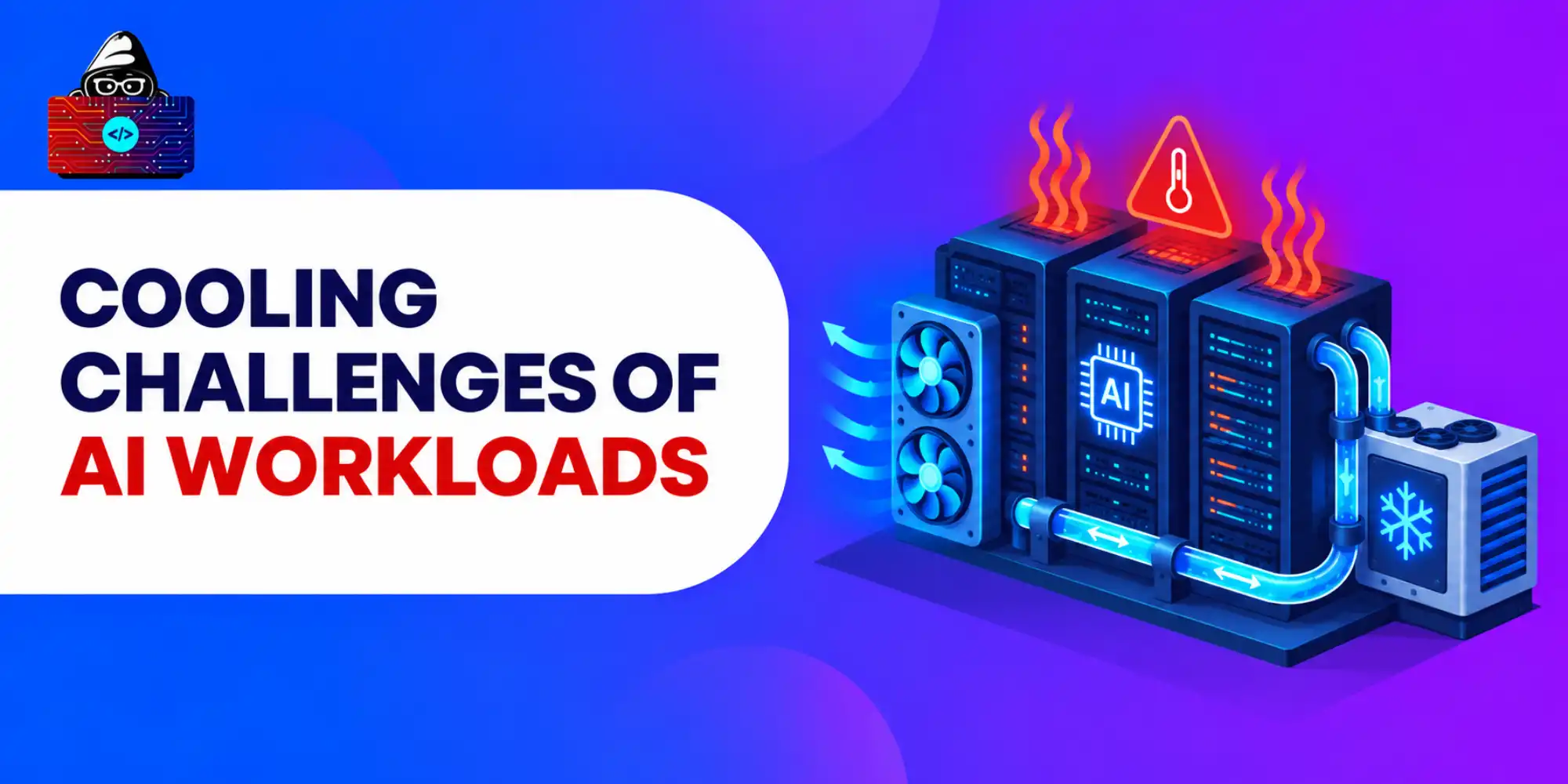

Artificial intelligence is changing what data centers need to remove from a server rack: heat. Training and running large AI models can require dense clusters of GPUs and other accelerators operating for extended periods. That concentration of computing power produces thermal loads that can exceed what many facilities were built to handle.
AI Changes the Heat Density Problem
Traditional enterprise servers may be distributed across racks with enough space and airflow to remove heat through conventional air cooling. AI clusters can concentrate far more electrical power into the same physical footprint.
A rack filled with accelerators creates a different thermal environment from one containing lower-density general-purpose servers. Fans must move greater volumes of air, and cooling equipment has to remove heat fast enough to keep processors within acceptable operating temperatures.
The problem becomes more difficult because AI workloads can sustain high utilization. Instead of experiencing short processing peaks followed by lighter periods, accelerators may remain heavily loaded during long training or inference jobs. Cooling capacity has to account for sustained thermal demand rather than an occasional spike.
Air Cooling Eventually Faces Physical Limits
Air cooling remains practical for many computing environments. Cold air enters server equipment, absorbs heat from components, and leaves as warmer exhaust air. Data centers can improve the process through hot-aisle and cold-aisle layouts and careful placement of perforated floor tiles or vents.
Higher rack densities make the process harder. Air has a relatively limited capacity to carry heat compared with liquids. Moving more heat therefore requires moving more air or increasing the temperature difference.
That can mean larger fans and greater fan power. Poor cable management, blocked vents, recirculation, or gaps between servers can further reduce cooling performance. Simply lowering room temperature is rarely an efficient answer. The real issue is getting cooling to the components generating the heat and moving that heat away.
Liquid Cooling Moves Heat Closer to Its Source
Liquid cooling is becoming increasingly relevant for high-density AI hardware because liquids can transfer heat more effectively than air. Rather than relying entirely on room air to cool powerful processors, a data center liquid cooling system can move heat away from high-temperature components using coolant. Direct-to-chip cooling typically uses cold plates attached to processors or accelerators.
Immersion cooling takes a different approach by placing equipment in a dielectric fluid that can safely contact electronics. The fluid absorbs heat directly from the hardware. Each method affects server design, piping, maintenance practices, facility infrastructure, and equipment selection. Adopting liquid cooling is therefore an architectural decision rather than a simple equipment upgrade.
Cooling Has to Be Planned With Power
Electrical and thermal planning are closely connected. Nearly all electrical power consumed by computing equipment eventually becomes heat that has to leave the facility. Adding a high-density AI cluster can therefore stress two systems simultaneously. The data center needs enough electrical capacity to run the hardware and enough cooling capacity to remove the resulting heat.
This connection makes power-per-rack estimates increasingly important during capacity planning. A room may have physical space for additional racks while lacking the electrical distribution or cooling capacity to operate them safely.
Operators also need to consider backup systems. If cooling is interrupted while processors remain active, temperatures can rise quickly in dense environments. Monitoring and automated controls need to identify abnormal conditions early enough for workloads to be reduced or equipment shut down safely.
Existing Data Centers Create Retrofit Challenges
New facilities can be planned around high-density computing from the beginning. Existing data centers face a different problem. Floor layouts, ceiling heights, piping routes, electrical distribution, chillers, pumps, heat exchangers, and structural loading may constrain available options. Introducing liquid cooling can require substantial changes even if only part of the facility will host AI equipment.
Mixed environments are particularly challenging. Conventional servers may remain air-cooled while AI racks require liquid cooling. Operators then have to manage multiple cooling methods within the same building.
Water and Energy Use Matter at Facility Scale
Cooling performance cannot be evaluated solely by processor temperature. Data centers also have to consider the resources required to reject heat outside the computing equipment.
Some cooling designs use significant amounts of water, while others place greater demands on electrical systems. Local climate affects the available options. A strategy that performs efficiently in a cool, dry region may behave differently in a hot or humid environment.
Operators should therefore evaluate cooling as a complete system. Moving heat efficiently from a GPU is only one stage. That heat ultimately has to be transferred and rejected somewhere else.
AI workloads are forcing data centers to treat cooling as a central infrastructure constraint rather than a supporting utility. The most effective strategy starts with the workload and treats power, cooling, monitoring, and maintenance as interconnected parts. Look over the accompanying infographic below for more information.