
Salesforce Marketing Cloud is not a tool you bolt onto a stack. It becomes the operating system for how your business talks to people, at scale, in real time, across the messy edges where data, product, and attention collide. How you staff that system quietly shapes speed, resilience, and what you can ask it to do tomorrow. This isn’t a headcount fight. It’s a capability, risk, and ambition alignment.
Pick the wrong model, and you’ll move slowly, spend more, or simply fail to turn platform potential into business outcomes. Pick the right model, and you’ll move faster, learn faster, and sleep easier when signals spike.
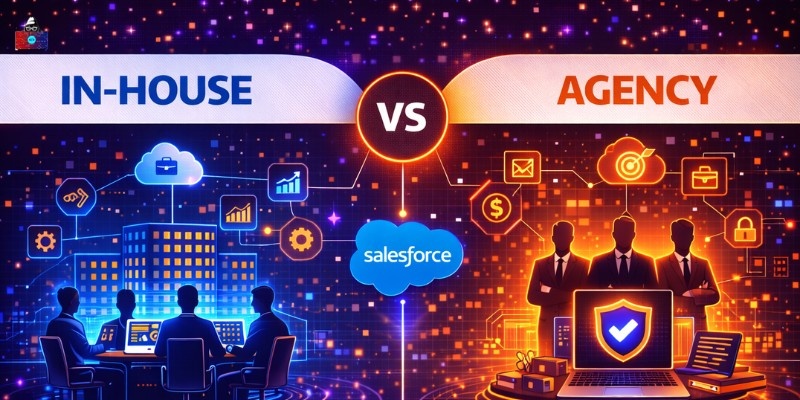
Let’s cut to the chase and learn what Salesforce Marketing Cloud Services providers offer differently from an in-house agency.
Table of Contents
|
Why this decision is harder than it looks
There’s a tidy myth: in-house = control , while agency = extra hands.
Reality is messier.
SFMC today touches:
- data architecture and identity graphs,
- AI-driven decisioning,
- cross-cloud activation,
- consent, suppression, and auditability.
Each adds friction and failure modes.
As SFMC gets more capable, the cost of being under-resourced or mis-resourced compounds quietly and quickly. Many teams outgrow their choice long before they recognize it.
So the question isn’t just “who will build this?” It’s “who will keep this system healthy, evolving, and aligned to business risk?”
But first, let’s dig deeper into in-house SFMC.
What “in-house SFMC” really means
Running SFMC internally looks simple on a job ad: hire a marketer, a developer, and an ops lead.
In practice, it requires greater skills:
- data modeling and subscriber architecture,
- AMPscript and programmatic logic,
- journey design that thinks in probability, not checklists,
- model monitoring and release management,
- QA, rollback plans, and deploy discipline.
|
Advantages |
Limitations You Must Admit |
|
Domain knowledge that lives inside the organization |
Hiring is slow and expensive |
|
Faster stakeholder alignment |
Skills are rare and vulnerable to churn |
|
Ownership of institutional memory |
Teams often burn out on tactical requests |
|
New SFMC capabilities like AI decision layers and Data Cloud tie-ins require specialist experience |
If you build in-house, design for hiring and for knowledge handoff, not hope. Now, let’s see what will an SFMC agency bring to the table.
What a strong SFMC agency actually brings
Good agencies are not “more hands.” They are pattern libraries turned operational, offering deep expertise and reliable Salesforce Marketing Cloud services.
They bring:
- repeatable architecture for identity, events, and journeys,
- exposure to failure cases across clients,
- rapid experiments and iteration velocity,
- embedded specialists (data engineers, deliverability, modelers).
Benefits:
- faster time to value,
- scale without hiring dozens,
- continuous learning as the platform evolves.
Trade-offs:
- less immediate business context,
- risk of dependency without enablement,
- need for crystal-clear governance and ownership boundaries.
An agency’s advantage is experience density. Your job is to capture that into your systems, not to outsource responsibility.
Now, let’s head a little more into SFMC.
The hidden variable: platform complexity and maturity
Treat this like a maturity curve.
Early stage SFMC:
- Few sources, simple journeys, limited personalization.
- In-house often makes sense.
Mature SFMC:
- Multiple business units, streaming events, real-time decisioning, and advanced personalization across channels.
- The surface area and risk increase dramatically.
As complexity grows, pure in-house becomes costlier to sustain. The right play often flips from “build everything” to “own strategy, partner for scale.”
Ask: how complex will you be in 12 months, not just today.
So, how will the cost impact your business? Let’s find out.
Cost is not the metric, total system risk is
Hiring vs retainer debates miss the real ledger.
Compare not salary to retainer, but:
- ramp time and time-to-value,
- attrition and knowledge loss,
- platform under-utilization,
- single points of failure.
Real risks:
- stalled innovation when no one owns upgrades,
- compliance gaps that cost trust,
- AI misuse because decisioning lacked guardrails.
The most expensive outcome is a system that “works” but underperforms quietly, leaking revenue, trust, and time. Measure options by system risk reduction, not just monthly cost. And that’s why it's difficult to choose between the in-house teams and the SFMC agency. And that’s exactly why you need to get to the common ground.
The hybrid model: why most teams end up here
Hybrid = leverage with ownership.
Core in-house team for: strategy, business context, and core data ownership.
Agency for: pattern design, scaling campaigns, advanced models, rare expertise, and a scalable suite of Salesforce Marketing Cloud services.
This model buys speed and resilience without replacing institutional knowledge. Success depends on clear division: who designs, who executes, who governs.
Define those roles early and operationalize them: playbooks, SLAs, and handoffs.
Need some more pro tips for implementation? We have got you covered.
A practical decision framework for leaders
Answer five questions honestly:
- How complex is your SFMC estate now, and how complex will it be in 12 months?
- Do you need execution velocity, system design, or both?
- How critical is speed to market for your competitive position?
- How far are you going with AI decisioning and real-time activation?
- Where do you need redundancy to reduce single points of failure?
Make the model support where you’re going, not where you are. If your roadmap includes Data Cloud, agentic journeys, or cross-cloud orchestration, weigh agency partnership or hybrid early.
Wrapping up
That brings us to the business end of this article, where it’s fair to say that the right choice evolves with your system. In-house vs. agency is not a permanent verdict. It’s a stage decision. Early on, in-house clarity and speed matter. Later, experience density and systems thinking scale better with partners. The clearest signal of maturity isn’t headcount. It’s whether your team treats SFMC as a system to be grown, audited, and improved, not a place to dump campaigns.
The real question: who is accountable for making Salesforce Marketing Cloud smarter over time? That person (or team) should come with a plan, not just a resume.