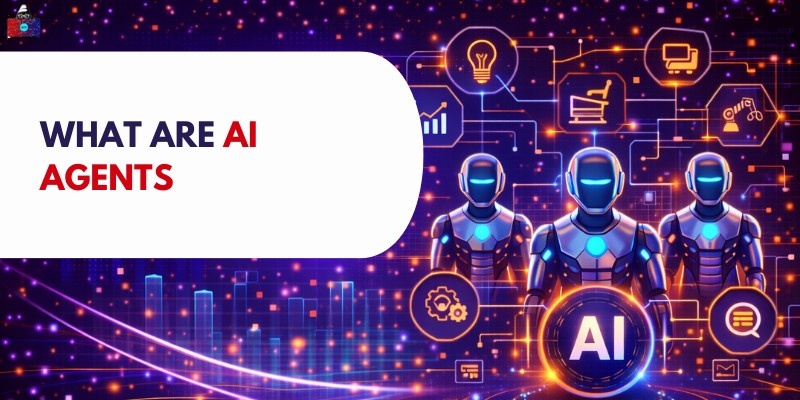

Out there in the digital world, smarts aren’t just coded steps anymore. Machines now chew through information, weigh choices, then act on their own. People usually call these thinkers AI agents. Whether it’s a voice helper, a self-driving car, or something suggesting your next video, they’re slipping into every tech space around us.
What Are AI Agents?
An AI agent is a software program or system that can observe its surroundings, process information, and take actions to achieve specific goals. It uses data, algorithms, and sometimes machine learning to make decisions and perform tasks automatically or with minimal human help.
In simple words, an AI agent follows a basic cycle:
- Perception: It observes the environment and collects information.
- Decision-making: analyzing information and deciding what to do.
- Action: It performs the appropriate action based on its decision.
This continuous cycle helps AI agents work intelligently and adapt to changing situations.
Key Features of AI Agents:
- They can work autonomously without constant human control.
- They can analyze data and make logical decisions
- They can learn and improve from experience (in advanced systems).
- They can interact with users, systems, or environments.
- They are designed to achieve specific goals efficiently.
Examples of AI Agents:
- Simple AI agents: Chatbots that answer user questions.
- Virtual assistants: Siri, Alexa, or Google Assistant.
- Recommendation systems: Suggest movies, products, or content.
- Advanced AI agents: Self-driving cars that make real-time driving decisions.
Purpose of AI Agents:
The concept of AI agents comes from artificial intelligence research, where systems are created to act intelligently and achieve defined objectives. AI agents can work independently, assist humans, or collaborate with other AI systems to complete tasks faster, more accurately, and efficiently.
Types of AI Agents
1. Simple Reflex Agents
These agents respond directly to specific inputs using predefined rules. They do not consider past experiences or future outcomes when making decisions. For example, a basic thermostat that turns on heating when the temperature drops is a simple reflex agent. They are fast, reliable, and easy to design and implement.
2. Model-Based Agents
Model-based agents maintain an internal representation of their environment. This allows them to make better decisions by considering past states and accurately predicting future conditions. They track changes over time and update their internal model, improving performance, adaptability, awareness, and overall decision-making efficiency in dynamic environments.
3. Goal-Based Agents
Outcomes shape how these agents act. Whichever move gets closest to the target tends to win out. Picture a map guiding you fastest from A to B; that is one in action. Planning matters most when picking paths through options. Reaching the right spot drives every choice they make.
4. Utility-Based Agents
At the start, these agents consider several options before choosing the option that yields the highest value across various settings. One thing they weigh is how quickly something gets done, along with expenses and results. What matters also is whether users end up happy with the outcome. Their choice often lands on whatever mix gains the most while keeping trade-offs steady.
5. Learning Agents
Learning agents improve their performance over time by continuously analyzing feedback and adapting to new data and experiences. They use machine learning techniques to refine their decision-making processes. This allows them to become smarter, more accurate, and more efficient, and to handle complex tasks and changing environments.
How AI Agents Work
Starting, these systems take in data before doing anything else. After that comes the part where thoughts get sorted, like how people think, but with circuits instead. Decisions pop up once the thinking settles, shaped by what came before.
1. Input (Data or Environment)
A signal arrives. It might be sound picked up by a microphone, a click on a screen, or numbers flowing from a database. Take the helper that listens when someone speaks - it catches words shaped into audio waves. Elsewhere, software tracking what people do online uses those patterns to guess what comes next.
2. Decision-Making Using Algorithms or Models
When it gets the input, the system works through information with coded methods or trained patterns. Depending on what it aims to do, it weighs choices before picking a reply that fits its design.
3. Action or Output
Once it decides what to do, the system moves forward by doing something. That might mean delivering information, changing how a gadget works, guessing an outcome, or handling something involved, like steering a car down a road.
4. Feedback and Learning Process
Over time, some AI systems get sharper thanks to real-world input plus experience. Outcomes guide machine-learning-driven ones, shaping how they act next. Getting things right more often comes from this constant cycle of tweak and test.
Key Components of AI Agents
1. Sensors (Data Collection)
Out there, bits of info get picked up by sensors. Software might pull these pieces from things like requests typed in, system records, or connections between programs. Robots and machines grab them through gear-like video eyes, sound listeners, or parts that sense movement.
2. Processing Unit (AI Model)
After receiving data, the processor digs into it with formulas or trained patterns. What happens next depends on how this part reads signals and chooses responses.
3. Decision-Making System
From time to time, this part checks what moves might work. It picks one that fits set guidelines, aims, or value measures instead. Choices here often rely on reasoning, odds, or methods meant to improve results somehow.
4. Actuators (Actions Performed)
When an agent needs to do something, it uses actuators to make it happen. Sending a reply or changing data inside a system counts as action in programs. Motors move parts when robots act in real space. Physical doing comes down to levers, gears, wheels - things that push or turn.
5. Learning Mechanisms
Over time, AI agents get better thanks to learning methods. As fresh information comes in, these systems adjust using machine learning tricks. Predictions grow sharper because the software learns from each example. Performance climbs when the agent fine-tunes itself through experience.
Real-World Examples of AI Agents
1. Virtual Assistants
Voice assistants like Siri and Alexa act as AI agents that process voice commands, answer questions, and perform tasks such as setting reminders or controlling smart devices.
2. Chatbots and Customer Support Bots
Businesses use chatbots to handle customer inquiries, provide support, and automate responses. These AI agents improve customer experience and reduce workload for support teams.
3. Autonomous Vehicles
Self-driving cars use AI agents to analyze traffic conditions, detect obstacles, and make driving decisions. These systems rely on sensors, machine learning models, and real-time data processing.
4. Smart Home Devices
Smart thermostats, security systems, and lighting controls use AI agents to automate home environments based on user preferences and environmental data.
5. Recommendation Engines
Streaming platforms and e-commerce websites use AI agents to recommend content or products based on user behavior and preferences.
6. Gaming AI
Video games use AI agents to control non-player characters (NPCs), making them react intelligently to player actions.
Applications of AI Agents
1. Healthcare
From spotting illnesses to keeping tabs on recovery, these tools support healthcare teams. When it comes to studying test results, they provide physicians with greater clarity. Through smoother daily operations, hospitals run with fewer hiccups. With better insights, care quality tends to improve over time.
2. Finance
One way banks use artificial intelligence is to spot fraudulent transactions. Suspicious patterns get flagged fast when software reviews money movements. Trading decisions happen through automated rules instead of human guesses. Service tasks run smoother because machines handle routine questions. Watching every transfer helps catch problems early.
3. E-Commerce
Shopping sites tap AI tools that tweak suggestions based on what you browse, while also tracking stock levels behind the scenes. These digital helpers reply to user questions without human input and adjust their responses over time. Behind each screen, silent programs shift tactics when supplies run low or demand spikes suddenly.
4. Cybersecurity
When something moves across a network, AI agents watch it closely. Threats arise; responses follow without waiting. Protection kicks in because systems need shielding. Data stays safer when these tools are at work.
5. Education
A single glance at how a student answers questions helps shape what they see next. One step further, their mistakes guide fresh choices in practice tasks. From there, new resources appear depending on how quickly progress occurs. When patterns shift, so do the suggestions nearby. Each move adjusts quietly behind the scenes.
6. Robotics
Machines guided by smart software handle tasks such as building things, moving goods, or exploring unfamiliar places. While some work on assembly lines, others sort packages. Even deep underground or far away on planets, they operate without human hands. These helpers follow digital thinking to get chores done where people might struggle.
Benefits of AI Agents
1. Automation of Tasks
AI agents automate repetitive and time-consuming tasks, allowing humans to focus on strategic work and more creative responsibilities. They reduce manual effort, minimize errors, save valuable time, and improve overall workflow efficiency across various industries and business operations effectively.
2. Improved Efficiency
They process data quickly and perform tasks accurately, improving productivity and operational efficiency in different environments. AI agents reduce delays, increase speed, handle large workloads easily, and ensure consistent performance, helping organizations achieve better results and complete tasks faster.
3. 24/7 Availability
AI agents can operate continuously without fatigue, providing round-the-clock support and services to users worldwide. They do not require breaks, sleep, or downtime, ensuring constant availability, faster responses, reliable assistance, and uninterrupted service for customers, businesses, and critical systems.
4. Better Decision-Making
By analyzing large datasets, AI agents provide insights and recommendations to support informed decision-making. They quickly identify patterns, trends, and risks, helping organizations make accurate, data-driven decisions, reduce uncertainty, and improve planning, strategy, and overall business performance.
5. Cost Reduction
Automation and efficiency improvements help organizations reduce operational costs significantly over time. AI agents lower labor costs, minimize errors, reduce resource usage, and improve productivity, allowing businesses to save money while maintaining high-quality services and consistently efficient operations.
Conclusion
AI agents are a fundamental component of modern artificial intelligence systems. They enable machines to perceive environments, make decisions, and perform actions autonomously. From virtual assistants and chatbots to autonomous vehicles and smart devices, AI agents are transforming industries and everyday life.
As technology continues to evolve, AI agents will become more advanced, collaborative, and intelligent. Their ability to learn, adapt, and automate tasks makes them essential for digital transformation and innovation. Understanding AI agents helps individuals and organizations prepare for a future driven by intelligent automation.
People are also reading: