
There is no denying that computers have benefited every sector, from education and healthcare to agriculture and government agencies. They have left no field untouched, automating various operations and processes and saving significant time and manual effort.
Computers have made the execution of complex tasks possible within fractions of a second. Hence, professionals, individuals, and even children rely on computer systems these days. Speed, accuracy, consistency, storage capacity, and versatility are a few major characteristics of computers that contribute to their widespread popularity.
While computers offer several benefits, they come with a few limitations. There are certain tasks that humans can do and computers cannot. Though technology advances, there are few areas where humans outperform computers.
In this article, we shall discuss the major limitations of computer systems.
What is a Computer?
A computer is a machine or electronic device that stores and processes data as per the set of instructions called a program fed to it. Basically, it accepts the input (raw data) from users, processes it according to a program, and generates the output.
Computers require hardware, a primary software program called an operating system , and peripheral devices, such as input and output devices, to work as intended. Users provide input through input devices, and the computer displays the output in an understandable format on output devices as preferred by users.
10 Significant Limitations of Computer Systems – Unveiling the Downsides
Let us now dive deeper into the areas where humans stand out from computers.
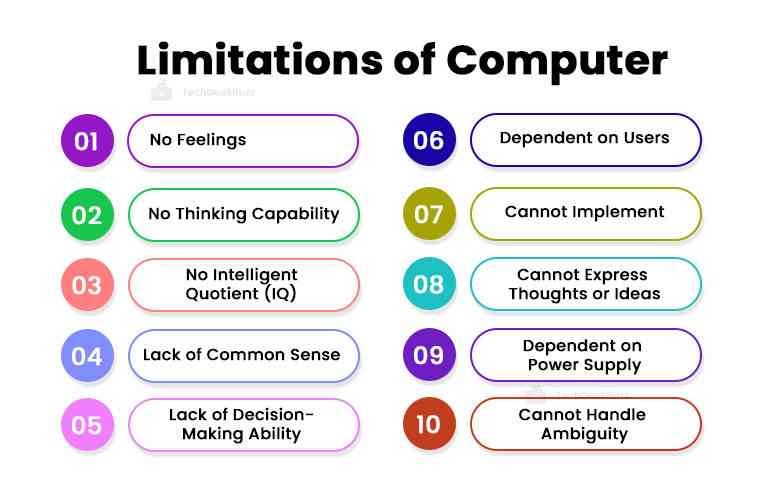
1. No Feelings
A computer is just a machine made of a combination of hardware components and a software program. Hence, it does not have any feelings and emotions like humans.
If humans work tirelessly for long hours, it is obvious to develop the feeling of tiredness. However, it is not the case with computers. As long as the user wants, they can work tirelessly with accuracy for long hours.
Additionally, specific tasks require ideas and opinions. For instance, you may want ideas from experienced professionals for starting a new business venture or seek their opinions. Only humans can perform this task and provide appropriate opinions and ideas.
2. No Thinking Capability
A computer is a human-made machine. It completely relies on the input given by a user and the instructions or programs fed to it. It does not have the ability to think on its own and perform tasks.
Without programs or sets of instructions used to perform certain tasks, computers are just useless boxes. They work on the algorithms developed by humans.
With the advent of artificial intelligence (AI), computers have become smarter, as they can learn from previous experiences and generate output. However, we cannot say that computers have developed thinking capabilities because humans have programmed them to learn on their own and produce output.
3. No Intelligent Quotient (IQ)
Intelligent Quotient (IQ) is a standard score that determines an individual’s intelligence, reasoning ability, or mental ability.
As computer systems do not have thinking capability, they have no IQ. They only respond to situations for which they are instructed or programmed to do. If we force them to carry out a task for which they are not programmed, they cannot do it at all. So, whatever a computer can do, it already has a set of instructions stored in it.
Modern computers have become smarter because they are fed with more instructions or programs to perform diverse and complex tasks.
4. Lack of Common Sense
Common sense is the ability to notice, understand, and make judgments about a specific situation using intelligence.
Computers cannot think independently and have no feelings, so they lack common sense. They provide accurate results (instead, results) if they are provided with proper input and instructed with programs to perform a particular computation.
Even computers with artificial intelligence or other AI models lack common sense. For instance, ChatGPT, one of the AI models that have taken the world by storm, can process and analyze vast amounts of data and generate human-like responses. It does not have common sense and intuition.
Let us take the common example of Microsoft Word. If we write the following sentence -
“A flower is a good person, and it is holding John”.
There will be no errors displayed if you write this sentence in Word. This means computers do not have the ability to understand the meaning or context of the text. If we provide the same sentence to humans, they can easily provide their judgments, saying it is a wrong statement.
5. Lack of Decision-Making Ability
Decision-making is the process of making a firm choice among several alternatives. It involves evaluating the pros and cons of alternatives and making the best decision. Hence, it requires intelligence, immense knowledge, wisdom, and the ability to judge. As computers lack all of these aspects, so do they lack decision-making ability. They simply function according to the given instructions.
Well, programming languages have constructs that help computers make the decision from the given alternatives. These constructs are if…else, for loop, nested if…else, and switch case statements. Based on the provided conditions, computers are able to make decisions. Still, they do not do this on their own but are programmed to do so.
6. Dependent on Users
Computers are solely dependent on humans for input and programming. Though they automate various routine tasks, they require human instruction in the form of programs and algorithms to do so. These programs and algorithms instruct computers to process and analyze data or input and perform the required tasks.
Hence, computer systems need human intervention or assistance in most situations. They cannot work on their own.
7. Cannot Implement
Undoubtedly, computers can store vast amounts of data that a human brain cannot store or remember. However, the vast amounts of storage become useless without the ability to implement.
The lack of ability to implement, despite being able to store huge volumes of data, is the major limitation of computers. They can only implement or solve problems for which they are programmed. If you require them to implement a task without feeding the algorithm for the same, they fail to do so.
8. Cannot Express Thoughts or Ideas
With no feelings and thinking capability, computers have no thoughts and ideas. Hence, they are not creative like humans. They simply work on the provided instructions and algorithms and have no ideas of their own. As a result, they cannot express their thoughts on any specific discussion.
9. Dependent on Power Supply
To function, computers require a reliable, continuous power supply. Without it, computer components, such as the CPU, memory, monitor, and other peripheral devices, cannot operate. Sudden power outages can cause unexpected shutdowns, which may result in data loss or hardware failure. However, battery backup systems and uninterruptible power supplies (UPS) are in place to avoid such situations.
10. Cannot Handle Ambiguity
Computer systems require concise and well-defined instructions without any ambiguity or unclarity. If these instructions are not clear or incomplete, computers fail to generate accurate results.
Additionally, with their thinking capability and intelligence, humans can infer meaning and make guesses with ambiguous data. This is not the case with computers.
Real-Life Examples of Limitations
Despite their advantages, computers and digital systems have several limitations that become evident in real-world scenarios:
- Lack of Human Judgment: In healthcare, AI systems can assist doctors but cannot replace human decision-making in complex or emotional cases, such as critical diagnoses or patient care.
- Dependence on Input Quality: In business analytics, incorrect or incomplete data leads to flawed insights, often resulting in poor strategic decisions.
- No Creativity or Intuition: Automated content generation tools can produce text quickly but often lack originality, emotional depth, or creative thinking compared to humans.
- Vulnerability to Errors: Software bugs or system glitches can cause major disruptions, such as banking system failures or airline booking errors.
- Security Risks: Cyberattacks like hacking and phishing exploit system vulnerabilities, leading to data breaches and financial losses.
- Limited Understanding of Context: Chatbots and automated customer support systems may misinterpret user queries, leading to unsatisfactory responses.
- Dependence on Power and Connectivity: Systems fail during power outages or internet disruptions, affecting services like online payments and communication.
Can AI Overcome These Limitations?
- Improved Decision Support: AI can assist in complex decision-making by analyzing large datasets, especially in fields like healthcare and finance. Still, human judgment remains essential for ethical and critical decisions.
- Better Data Handling: Advanced AI models can clean, organize, and validate data, reducing errors caused by poor input quality. However, eliminating bad data is still challenging.
- Enhanced Automation and Learning: Machine learning allows systems to improve over time, making them more accurate and efficient in tasks like fraud detection and recommendation systems.
- Context Awareness Improvements: Natural Language Processing (NLP) has improved AI’s ability to understand context, making chatbots and virtual assistants more effective, though not perfect.
- Stronger Security Measures: AI helps detect cyber threats in real time, but attackers also use AI, creating an ongoing arms race in cybersecurity.
- Reduced Human Effort: Automation powered by AI minimizes repetitive tasks, increasing productivity across industries.
Conclusion
This was all about the limitations of computer systems. Humans outperform computers in terms of the above limitations. Despite these limitations, the revolution and benefits they offer to humans are immense.
However, advancements in artificial intelligence, natural language processing, and machine learning can overcome these limitations in the future.
Currently, combining human expertise and computers’ computational power can make many impossible tasks possible.
People are also reading:


![What is an Assembler? [Definition, Working, & Types]](https://storage.googleapis.com/techgeekbuzz/media/new_post_images/What_is_Assembler.jpg)