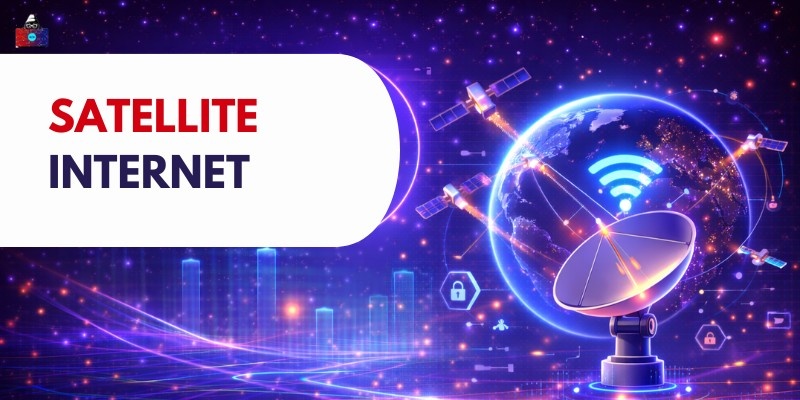

Internet connectivity has become a basic necessity for communication, education, business, entertainment, and emergency services. Out there, another path opens, one that climbs straight up into space. Signals bounce off high-flying machines orbiting Earth. No digging trenches. No stringing wires across valleys. Just invisible beams linking ground devices to satellites above. When land-based systems fall silent, these sky relays keep talking. Distance matters less once the route goes upward. Even in forgotten corners, a dish pointed at the sky can spark contact. This isn’t future talk. It functions now. For villages cut off by terrain, storms, or isolation, help arrives from orbit. Not perfect. Not instant. Be present. Where roads fail, and poles collapse, the view overhead stays clear. A single connection might begin with a small antenna facing clouds.
How Satellite Internet Works
1. Role of Satellites, Ground Stations, and User Dishes
Satellite internet relies on three main components:
- Satellite: Orbiting the Earth, it acts as a relay station for data signals.
- Ground Stations (Gateways): These are terrestrial facilities connected to the global internet backbone.
- User Dish (Satellite Antenna): Installed at the user’s location to send and receive signals.
A signal jumps from the dish to the modem, opening a path for data on radio waves. Radio links carry information between the device and the satellite, making communication possible. Information flows when the outdoor unit talks to the indoor box through invisible channels. The link forms as soon as the hardware pairs using wireless signals. Connection happens through airwaves, passing details back and forth.
2. Data Transmission Process (Uplink and Downlink)
The data flow works as follows:
- A user sends a request (e.g., opening a website)
- From the dish, the signal heads upward toward the satellite. It travels through space on an uplink path. Reaching orbit, it connects with the satellite overhead. The link opens one way at a time. Moving fast, data leaps from Earth into the sky.
- Flying high above Earth, the satellite sends information down to a receiving center on land.
- From the soil-up post, web pathways open. The reply came back through that same link.
- A signal bounces back through space, reaching the person below via the orbiting machine.
A single journey back and forth takes just a few thousandths of a second, shaped by how high the satellite flies.
3. GEO, MEO, and LEO Satellites Explained
Satellite internet systems differ based on orbital altitude:
- GEO (Geostationary Earth Orbit): ~35,786 km above Earth
- MEO (Medium Earth Orbit): ~2,000, 20,000 km
- LEO (Low Earth Orbit): ~500, 2,000 km
The orbit type directly impacts speed, latency, and coverage
Types of Satellite Internet
1. Geostationary Orbit (GEO) Satellite Internet
GEO satellites remain fixed relative to Earth’s surface.
Characteristics:
- It gives you the Wide coverage with fewer satellites
- There will be High latency due to the long signal distance
- Common in traditional satellite broadband
Examples: HughesNet, Viasat
2. Medium Earth Orbit (MEO) Satellite Internet
MEO satellites offer a balance between coverage and latency.
Characteristics:
- It gives you the Moderate latency
- Fewer satellites than LEO
- Often used for enterprise and government communication
3. Low Earth Orbit (LEO) Satellite Internet
LEO satellites orbit much closer to Earth and move rapidly.
Characteristics:
- Low latency comparable to fiber or DSL
- Requires large satellite constellations
- Rapid deployment and better performance
Examples: Starlink, OneWeb
Satellite Internet Providers
Several companies are shaping the satellite broadband market.
1. Starlink
- It is operated by SpaceX
- They usually use thousands of LEO satellites
- It offers low latency and high speeds
- Expanding global coverage rapidly
2. HughesNet
- GEO satellite provider
- It is widely available in rural regions
- It is known for best suited for basic internet needs
3. Viasat
- GEO-based satellite broadband
- Higher speed plans compared to traditional satellite services
- Strong presence in the aviation and maritime sectors
4. OneWeb
- LEO satellite network
- Focused on enterprise, government, and rural connectivity
- Emphasis on global internet access
5. Coverage and Availability
Satellite internet is available in areas where fiber, DSL, or mobile networks are limited or nonexistent. Coverage depends on provider infrastructure and regulatory approvals.
Advantages of Satellite Internet
1. Wide Coverage in Remote and Rural Areas
Satellite internet can reach the following:
- Remote villages
- Mountains and deserts
- Islands and offshore locations
This works well in places where standard networks just won’t fit. Known because getting into it feels simple.
2. Quick Deployment
Unlike fiber networks, satellite internet does not require extensive ground infrastructure. Users can get connected quickly with minimal setup.
3. Independence from Ground Infrastructure
Satellite internet remains operational even when:
- Natural disasters damage cables
- Terrestrial networks fail
- Infrastructure is unavailable
This tool proves useful when power fails or networks drop. One big reason people keep it around
Disadvantages of Satellite Internet
1. Latency Issues
Waiting happens when information moves slowly. Sometimes it takes a moment before things show up.
- GEO satellites experience high latency
- While LEO satellites cut down on the problem noticeably, they still leave some of it behind. Still, improvements exist where older systems struggled before. Yet full removal remains out of reach even with these newer models
Faster reactions matter when playing games online or talking through video calls. How quickly things happen can change how well you connect during these moments.
2. Weather Interference
When it rains or snows, signals from satellites often get weaker. This dip in strength shows up during heavy weather. Moisture in the air scatters the signal path. Strong winds mix into this effect, too. This result is called "rain fade" by experts.
3. Cost Considerations
Satellite internet often has:
- Higher equipment costs
- Monthly subscription fees
- Installation expenses
Costs could rise with LEO services because newer tech often demands higher prices.
4. Data Caps
A few satellite companies set caps on data, then slow things down once you go past them.
Satellite Internet Speed and Performance
- Internet Through Space: Unlike traditional internet that uses cables or fiber lines, satellite internet sends and receives data through satellites orbiting the Earth. This unique system allows people in remote areas to connect to the internet, even where cables cannot reach.
- Download Speeds : Modern satellite services can deliver download speeds of up to 200 Mbps, while many standard plans provide around 25 Mbps. These speeds are suitable for browsing websites, streaming videos, and downloading files.
- Upload Speeds : Upload speeds are usually lower than download speeds, typically ranging between 5 Mbps and 40 Mbps. This is generally enough for sending emails, uploading documents, storing files in the cloud, and participating in video calls.
- Latency and Distance : Traditional satellite internet relies on Geostationary Earth Orbit (GEO) satellites that orbit very high above the planet. Because data must travel such long distances, latency can reach 500 milliseconds or more, which may cause delays.
- Impact on Real-Time Activities : Higher latency can affect activities that require instant responses, such as online gaming, live video meetings, or real-time collaboration.
- Low Earth Orbit (LEO) Improvements: Newer systems use Low Earth Orbit (LEO) satellites that fly much closer to Earth. This shorter distance reduces latency to around 20–50 milliseconds, making streaming, gaming, and communication much smoother.
- Weather and Environmental Factors: Conditions like heavy rain, storms, or thick cloud cover may temporarily weaken signals and affect connection quality.
- Network Congestion: When many users access the network at the same time, speeds may decrease slightly due to shared bandwidth.
- Physical Obstructions: Objects such as trees, buildings, or mountains can sometimes block the signal path between the satellite dish and the satellite.
-
Reliable for Remote Areas
:
While it may not always match the stability of fiber or cable internet, satellite internet remains one of the most reliable options for rural and remote locations where traditional internet infrastructure is unavailable.
Conclusion
Getting online in remote locations often resulted in slow signals and frequent drops. Now, satellites circling low above Earth change that picture entirely. Instead of waiting minutes for a page to load, users see responses in seconds. Even so, cities packed with underground cables still find little reason to switch. Yet where wires never reached, these new networks act like lifelines. Speeds climb higher, delays shrink, and connections hold firm more often than before. Now shaping up fast, satellite broadband reaches homes, offices, agencies, and even rescue teams when ground options fail. Where you are matters, so do speed demands and cost limits, yet for countless people, this link works where others cannot.
People are also reading: